Wasteland Life: Survival Idle
- 3.9
- Rating
- 10.00M
- Installs
- Free
- Price

 Analysis by App-foxy
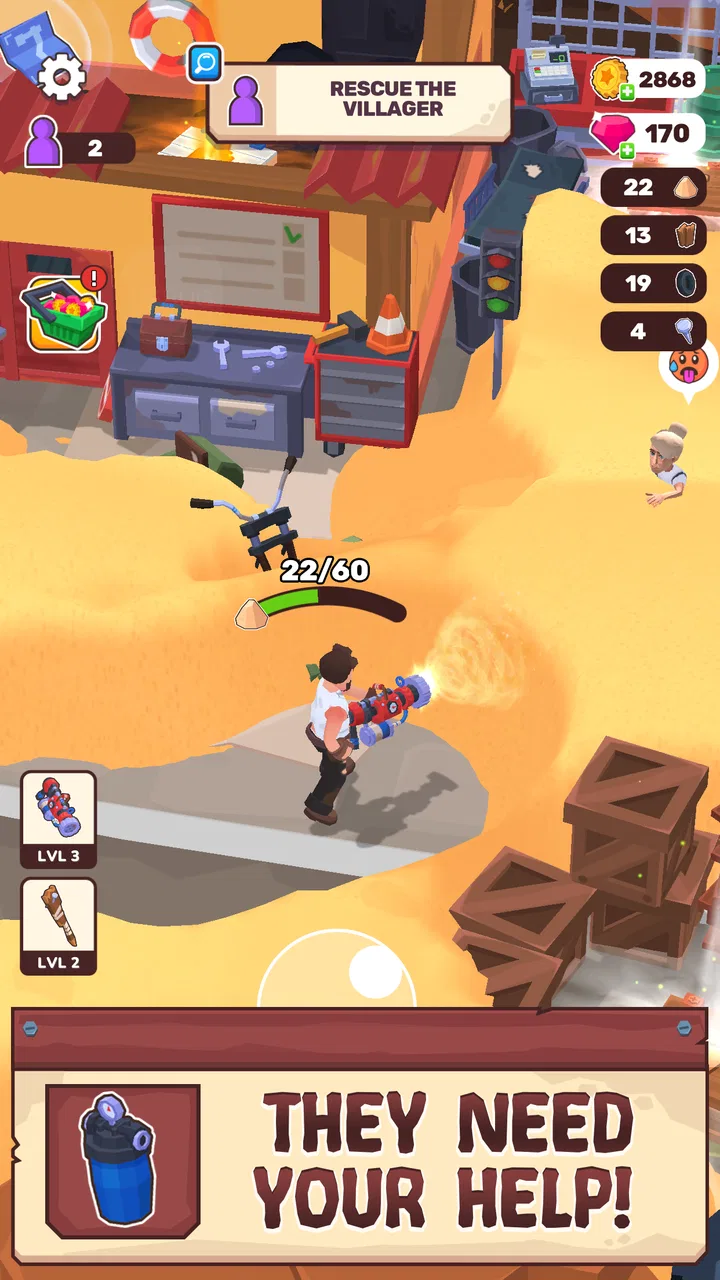
I found Wasteland Life: Survival Idle most interesting when I stopped treating it like a traditional role-playing adventure and started seeing it as a compact rebuilding routine. Its hook is simple: the world has been damaged by a sand apocalypse, and my job is to turn a harsh wasteland into a functioning settlement. The game mixes light survival themes with city building, resource management, and idle progression, but it keeps the controls approachable enough for short sessions.
My overall impression is that this is a relaxed strategy game wearing survival clothing. It gives me the satisfaction of collecting materials, improving useful areas, and watching a settlement become more capable, without demanding the constant attention of a deeper survival simulator. That makes it easy to recommend to players who want steady progress on a phone. It is less convincing for anyone looking for serious danger, complex role-playing choices, or a large world to explore freely.
Rebuilding a settlement one practical decision at a time
The central appeal is the gradual transformation of an empty, hostile-looking environment into something that feels organized. Early progress is easy to understand: gather what is available, use it to improve the settlement, unlock the next useful step, and repeat the process. I never felt lost about the immediate objective, which is important in a mobile game designed for quick visits.
You May Also Like

 Blood Strike: 2.5 Anniversary
Blood Strike’s Loadouts Turn Every Drop Into a Tactical Gamble
A close look at Blood Strike’s custom loadouts: how fast access to signature weapons reshapes its battle royale rhythm, rewards preparation, and narrows the gap between fights.

 Pandora - Music & Podcasts
Pandora’s Music Is Easy to Start, but Harder to Recover
Pandora’s strength is its low-effort path from a seed to a station. Its weak spot is how much confidence it asks you to place in connection, setup, and quiet recovery.

 8 Ball Pool
 Is Built on Rivalries, Rematches, and Routine
A close look at the rivalries, rematches, shared routines, and unanswered safety questions that turn a quick pool match into a persistent mobile community.

 Samsung Music
’s Quiet Strength Is Playing What You Already Own
Its reach comes less from spectacle than from dependable access to a personal library. That simplicity is both the app’s strongest retention engine and its ceiling.

 AccuWeather: Weather Radar
AccuWeather Review: A Quick, Clear Forecast for Everyday Decisions
For everyday plans, the best forecast is the one you can understand quickly. AccuWeather makes rain timing, radar, and local conditions easy to act on, with a few trade-offs.

 Hill Climb Racing
Why Hill Climb Racing Still Turns Crashes Into One More Run
A tiny car, a bumpy hill and one more upgrade: Hill Climb Racing keeps resurfacing because its simple chaos makes every near-miss feel personal.
More From Our News Desk
View All News


The role-playing label is present more in the setting and progression than in deep character development. I am not choosing from a huge range of dialogue paths or shaping a complicated hero with dozens of statistics. Instead, the role-playing feeling comes from becoming more capable as the settlement grows. Each improvement changes what I can do next, so the sense of development comes from the chain of upgrades rather than from a dramatic storyline.
The idle element also changes how I approach the game. I do not need to play for a long uninterrupted stretch to feel that I have made progress. A short visit can be enough to collect available resources, spend them on an improvement, and prepare the next objective. This works especially well when I want something to do while waiting for a bus, taking a break, or winding down before bed.
At the same time, idle progression can make the experience feel less urgent. In a survival game, I usually expect pressure: limited supplies, dangerous encounters, or consequences for poor planning. Here, the wasteland atmosphere is stronger than the punishment. The setting suggests desperation, but the moment-to-moment experience is generally more forgiving. That is a strength if I want a calm game, but a weakness if I want genuine survival tension.
Why the building loop works
The best part of the design is the clear connection between gathering and construction. Resources are not just numbers that disappear into an upgrade menu; they represent the practical steps needed to make the settlement more useful. I can see a reason to return because there is usually another improvement within reach, even when the larger goal is still far away.
I also like the way the game encourages me to think in small priorities. Rather than trying to improve everything at once, I get better results by focusing on the next bottleneck. If one resource is holding back progress, collecting that material becomes more valuable than casually gathering everything in sight. This is a small but meaningful strategy lesson, and it gives the simple loop more shape than the store summary alone suggests.
One useful habit is to avoid spending every resource immediately just because an upgrade is available. I found it more comfortable to keep a modest reserve for the next requirement, especially when several tasks compete for the same materials. This reduces the feeling of being stuck after an enthusiastic spending spree and makes each return to the game more productive.
Another practical approach is to treat each short session as a three-step visit: collect what has accumulated, complete the most efficient improvement, and leave with a clear next target. That rhythm keeps the game from becoming an unfocused sequence of taps. It also suits the idle structure better than trying to force a long play session out of it.
A mobile-friendly pace with a visible trade-off
The accessible pace is one reason the game has reached a broad audience. It is free to start, carries an Everyone 10+ content rating, and has passed ten million installs. Its average rating is 3.9 from roughly seventy-five thousand ratings, with about five thousand seven hundred written reviews. Those figures suggest a game that attracts plenty of interest while also producing a mixed reaction, which matches my experience: the core loop is easy to enjoy, but its simplicity will not satisfy everyone.
SayGames Ltd has kept the presentation focused on progress rather than overwhelming the player with systems. I can understand the basic purpose of an activity quickly, and the game does not require me to study a large manual before making useful decisions. For a phone game, that clarity matters more than having a complicated interface full of menus.
The trade-off is that the routine can become predictable. Once I understand the pattern of collecting, upgrading, and moving toward the next objective, the surprise comes mostly from the next piece of progress rather than from changing rules. Players who enjoy optimization may still find small decisions to refine, but players who need constant novelty may feel that the game settles into repetition.
This is also where it differs from more demanding survival alternatives. A traditional survival game may ask me to manage hunger, shelter, equipment durability, hostile creatures, and a changing environment. Wasteland Life is more interested in the satisfaction of rebuilding than in making every mistake costly. I can recommend it over those alternatives when convenience matters, but not when the main goal is tension and detailed survival simulation.
Where the experience starts to lose momentum
The biggest limitation is the balance between waiting and decision-making. Idle mechanics are useful because they let progress continue between sessions, yet they can also reduce the number of meaningful choices I make during a visit. If the next improvement depends on a slow accumulation of one resource, there may be little to do beyond checking in later.
That design is not automatically bad. It becomes frustrating only when I expect the game to provide a substantial activity every time I open it. I learned to treat it as a background progression game rather than a full evening adventure. When I followed that expectation, the pauses felt natural. When I wanted a longer, more active session, the limited depth became more noticeable.
The free-to-play structure adds another consideration. The game is free to download and includes optional purchases ranging from $0.99 to $99.99 per item. I would approach those offers carefully. The most sensible way to play is to decide in advance whether I am comfortable waiting for progress or whether I am tempted to pay to shorten that wait. The game is at its most enjoyable when I make that choice deliberately rather than reacting to a blocked upgrade.
For younger players, the age rating and purchase options are worth discussing with the person who manages the device. The setting is not aimed at very young children, and the presence of in-app purchases means a family should agree on expectations before play begins. That is not a reason to reject the game, but it is part of using a free mobile title responsibly.
I also would not choose this game as my main role-playing experience. The progression is pleasant, but it does not replace a narrative RPG with memorable characters, branching decisions, or a more elaborate combat system. If those elements are the reason I play role-playing games, I would be happier with a dedicated alternative and would treat this one as a lighter side game.
How I would use it in everyday play
Imagine having ten minutes during a lunch break. I could open the game, gather the resources ready for collection, inspect which settlement improvement is closest, and spend the remainder of the session working toward that target. If the next requirement is still out of reach, I can leave the game running as part of my normal routine and return later instead of feeling that I have wasted the visit.
That scenario shows the game at its best. It does not ask me to remember a complicated control scheme or reconstruct a long chain of events after a few hours away. The objective remains readable, and the settlement gives me a visual reminder of why the resources matter. It is a good match for players who enjoy seeing a place become more developed over time.
I found it helpful to play with a simple personal rule: never spend a rare-looking resource without checking what the next improvement needs. Even without turning the game into a spreadsheet, this creates a little forward planning. It also prevents the common idle-game problem of tapping every available button and then wondering why the next stage feels unexpectedly slow.
A second useful habit is to stop a session after completing a meaningful improvement rather than continuing until every resource is gone. Ending on a clear achievement makes the next return feel purposeful. This is particularly effective here because the game’s satisfaction comes from visible settlement growth, not from winning a single dramatic encounter.
Players who prefer active control can still make the collecting and upgrading loop feel more intentional by setting a short goal before starting. For example, I might decide to improve one specific part of the settlement or gather enough material for one construction step. That approach does not add new mechanics, but it makes the existing ones feel less repetitive.
Who should give it a try
I think the strongest audience is made up of casual strategy players who like rebuilding themes, incremental improvement, and games that respect short sessions. It is also suitable for someone curious about survival settings but unwilling to manage the demanding systems found in hardcore survival titles. The combination of a wasteland backdrop and gentle progression gives the game an approachable identity.
It should appeal to players who enjoy watching numbers and structures improve gradually, especially if they like checking a game several times throughout the day. The settlement-building goal gives the idle format more personality than an abstract upgrade screen, and the role-playing presentation helps make the long-term progression feel like a journey rather than a collection of unrelated tasks.
I would skip it if I need fast action, competitive multiplayer pressure, or a deep story. I would also look elsewhere if I dislike waiting mechanics or become annoyed when a game repeats the same resource routine for a long time. A more traditional role-playing game would be better for character-focused storytelling, while a dedicated survival game would be better for danger, exploration, and consequences.
Device compatibility is reasonably broad: the current version is 2.8.2 and it requires Android 8.0 or later. That makes it accessible to many Android users, although the practical experience can still depend on the phone and the way a person manages background play. I would keep expectations realistic and install it for its compact progression loop, not because it promises a console-sized survival adventure.
My verdict after settling into the wasteland
Wasteland Life: Survival Idle succeeds because it understands its own most useful idea: rebuilding a damaged world can be satisfying even when the rules remain simple. The sand-apocalypse setting gives the collecting and construction a clear purpose, while the idle structure makes progress easy to fit around everyday life. I enjoyed it most when I accepted its calm pace and focused on one practical improvement at a time.
Its weaknesses are equally clear. The survival theme promises more danger than the relaxed mechanics usually deliver, and the loop can become repetitive when progress slows. Optional purchases also make it important to decide whether I am happy to wait or likely to spend. Those are not minor details for everyone, especially players who want constant action or a fully developed role-playing system.
My recommendation is therefore specific: try it if you want a free, low-pressure city-building game with a wasteland atmosphere and idle progress. Keep it as a casual companion rather than expecting a demanding survival simulator. For that audience, the steady transformation from empty desert to organized settlement is enough to make the game worthwhile, and the best results come from playing patiently, saving resources intelligently, and treating each visit as one small step toward a better home.
FAQs for Wasteland Life: Survival Idle
01What is the main objective of Wasteland Life: Survival Idle?
Wasteland Life: Survival Idle is a post-apocalyptic survival game where the primary objective is to build and manage a shelter in a devastated world. Players must gather resources, craft tools, and fend off threats to ensure the survival of their community. The game combines strategy and idle gameplay, making it engaging for both active and casual gamers.
02Is Wasteland Life: Survival Idle free to play?
Yes, Wasteland Life: Survival Idle is free to download and play on both Android and iOS platforms. However, it contains in-app purchases that can enhance gameplay by providing additional resources or unlocking premium features. These purchases are optional and not necessary to enjoy the full game experience.
03What kind of gameplay experience can I expect?
Players can expect a mix of strategy, resource management, and idle gameplay. The game allows you to develop your shelter, gather resources, and explore the wasteland. The idle aspect means progress can continue even when you're not actively playing, making it suitable for both short play sessions and longer gaming marathons.
04Are there multiplayer or social features in the game?
Wasteland Life: Survival Idle includes social features that allow you to connect with friends, join alliances, and participate in cooperative events. These features enhance the gameplay by allowing collaboration and competition with other players, providing a more interactive and engaging experience.
05What devices and operating systems are compatible with the game?
Wasteland Life: Survival Idle is available on both Android and iOS devices. It requires Android version 5.0 and up, and iOS version 10.0 or later. The game is optimized for both smartphones and tablets, ensuring a smooth experience across different devices and screen sizes.
Pros
- Engaging idle gameplay mechanics.
- Vibrant post-apocalyptic graphics.
- Regular updates with new content.
- Simple controls
- easy to learn.
- Offline play available for convenience.
Cons
- In-app purchases can be pricey.
- Ads can interrupt gameplay flow.
- Progression may feel slow at times.
- Limited customization options.
- Some features require internet.

Wasteland Life: Survival Idle
Gallery